Kesradat: A Premium Sans Serif Font for Crafters & Sellers
As someone who hand-labels small-batch candles, designs wedding invitations in Canva, cuts vinyl signs for local boutiques, and sells printable planner pages on Etsy—I’ve learned that typography isn’t just decoration. It’s the first impression your product makes before a customer even reads a word. That’s why Kesradat instantly stood out to me—not as another trendy font, but as a quiet, confident workhorse built for real craft business needs.
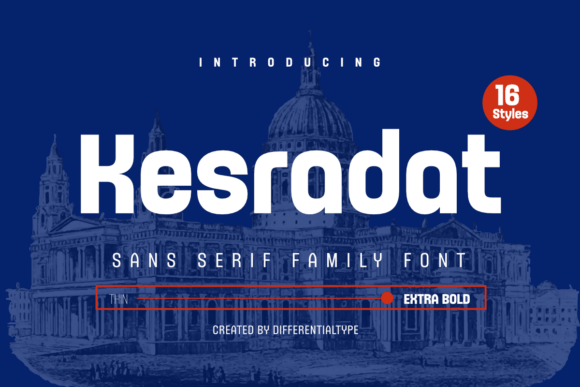
Kesradat is a clean, elegant sans serif font with subtle warmth—neither coldly technical nor overly playful. Its letterforms balance geometric precision with gentle humanist curves: think soft terminals on lowercase a, c, and e, generous x-height for legibility at small sizes, and consistent stroke contrast that gives it presence without shouting. It feels modern, yes—but also timeless enough to hold up on a farmhouse welcome sign or a luxury soap label five years from now.
What truly sets Kesradat apart for makers is its full 16-style range: Thin, Extra Light, Light, Regular, Medium, Semi Bold, Bold, Extra Bold—and each with matching Italics. That means I can use the delicate Thin weight for fine-print ingredient lists on skincare jars, switch to Bold for a bold “NEW” sticker on my seasonal mugs, and go all-in with Extra Bold + Italic for a hand-lettered-style quote on printable wall art—all while keeping brand cohesion intact. No more juggling three different fonts just to cover basic hierarchy.
I use Kesradat across nearly every physical and digital product I make. For candle and bath product labels? The Regular and Medium weights print crisply at 8–10 pt—even on matte kraft paper. For die-cut stickers and Cricut/Silhouette projects? Its open counters and generous spacing prevent cutting errors on tight curves (no stuck “e” or “a” interiors). Wedding stationery benefits from its refined elegance: I pair Kesradat Medium for guest names on place cards with Kesradat Light for RSVP details—clean, legible, and effortlessly upscale. And for holiday packaging? The Extra Bold weight holds up beautifully on red-and-gold gift tags, even when scaled down to 12 mm tall.
It shines in display roles too. A Kesradat Bold welcome board at a bridal shower reads clearly from six feet away. A Kesradat Semi Bold + Italic quote on a framed printable (“Breathe. Begin Again.”) feels grounded and sincere—not sterile or stiff. Even on fabric transfers for tote bags or tees, its balanced proportions prevent distortion during heat application, and the clean lines translate well to embroidery digitizing workflows.
Readability is where Kesradat earns its keep in production. Unlike some ultra-thin or condensed sans serifs, it remains highly legible at small sizes—critical for jar labels, price tags, and planner headers. On mockups, it previews accurately: no unexpected kerning gaps or awkward line breaks in PDF proofs. And because it includes standard OpenType features (ligatures, discretionary ligatures, and stylistic alternates), I can add subtle polish—like swapping in a swash capital “Q” for boutique signage—without switching fonts.
Font pairing is intuitive. I often combine Kesradat Regular or Medium with a relaxed script font (like a natural-looking handwritten script) for invitation suites—Kesradat handles all body text, headings, and addresses while the script adds personality to names and accents. For product packaging, I’ll pair Kesradat Bold with a warm, low-contrast serif font (think a friendly Garamond alternative) for ingredient lists or story blurbs—creating visual rhythm without competing voices. It also works beautifully solo: its range means you don’t *need* a second font for many projects, which simplifies design files and ensures consistency across SVG bundles and digital downloads.
Kesradat supports Latin-based languages and includes extended punctuation, fractions, and currency symbols—essential if you sell internationally or create bilingual baby shower invites. Files come in both OTF and WOFF formats, so whether you’re designing in Adobe Illustrator, Cricut Design Space, Silhouette Studio, or Canva, you’re covered. No missing glyphs mid-project. No last-minute font swaps.
One practical note every seller should remember: Kesradat is licensed for commercial use—including physical products, digital templates, SVG files, printables, merchandise, and client work. That means you can confidently embed it in your Canva templates, include it in your Procreate brush kits, or use it to design logos for local businesses. Just be sure to review the license terms for redistribution limits (e.g., end users shouldn’t be able to extract and install the font file itself from your template).
In my shop, Kesradat has quietly upgraded how customers perceive quality. A candle labeled in Kesradat Medium doesn’t just say “lavender vanilla”—it says “thoughtfully made.” A wedding welcome sign in Kesradat Bold doesn’t just direct guests—it sets a calm, intentional tone. Even my holiday mug collection feels more cohesive because the same font family anchors everything from packaging to social media graphics.
If you’re tired of fonts that look great on screen but fall apart when printed, cut, or scaled—or worse, limit your design flexibility—you’ll appreciate how Kesradat delivers both beauty and reliability. It’s not flashy. It doesn’t try too hard. But it shows up, consistently, across every project—from tiny sticker sheets to large-format wall art—and helps your handmade goods look like what they are: carefully considered, professionally presented, and deeply human.